

AI Productivity Killer: Managing Workslop in Your Business
As AI becomes more deeply embedded in our daily and business lives, we are starting to see a massive transformation in how work gets done.
Over the past few years, a rapid wave of adoption has touched businesses across industry lines and geographies, fueled by the premise that AI can unlock scale without proportionally increasing spending. Organizations are going all in, expecting AI to help employees do more with fewer resources across every function.
However, as organizations dive headfirst into this shift, the truth is proving to be far more nuanced.
The Rise of AI Workslop
Today, AI is a core part of how businesses operate. From drafting emails and summarizing meetings to generating reports, its role continues to expand. The overall gains in speed and volume from AI implementation are real and significant.
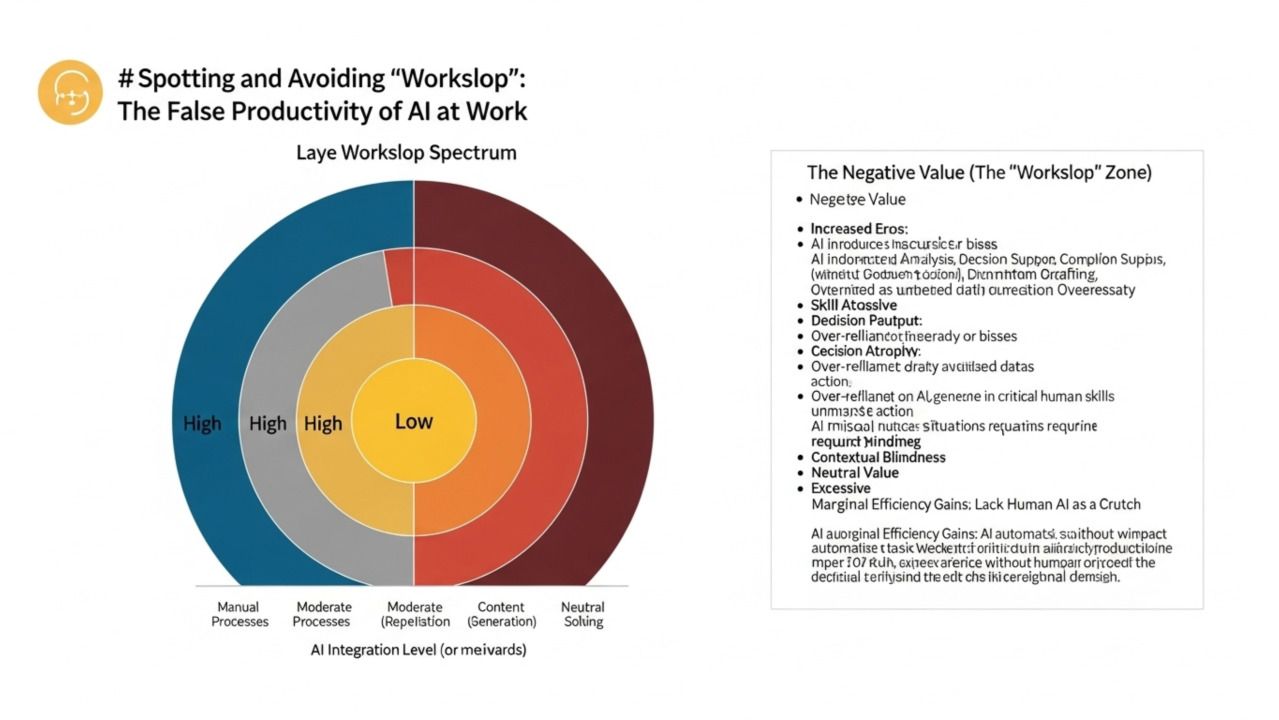
This kind of output undermines productivity and employee confidence.
But speed and volume are not everything. Quality matters just as much, and this is where the lines begin to blur.
One important thing to understand about AI is that large language models often sound confident and authoritative, even when they are wrong. They perform well across a wide range of tasks and often produce work that looks polished on the surface. Yet they can quietly miss the point, drop critical nuance, or make up details altogether, as often happens when the models hallucinate. This problem compounds when AI-generated work moves between employees without scrutiny. One person uses AI to produce a report; another receives it, assuming it has been carefully thought through. Each of these handoffs between employees or functions adds another layer of unquestioned trust, and the errors quietly stack up.
This is workslop: It is low-effort, low-quality AI output passed off as finished work.
Sometimes, this is deliberate. Sometimes, the sender does not even realize it falls short. What makes workslop particularly dangerous is how invisible it is. It creeps in gradually, and by the time it becomes visible, it is already widespread.
When it comes to AI adoption, organizations can easily track and celebrate it. What is far harder to measure is the quiet erosion happening underneath, the slow decline in the standard of work and the gradual loss of trust that follows.
Research from Stanford and BetterUp found that 41 percent of workers could recall a specific instance of workslop that affected their work. More than half admitted to sending it themselves, and one in ten said that 50 percent or more of the AI-generated content they shared with colleagues was unhelpful or low quality. For small businesses, where all output carries greater weight and fewer people are available to catch mistakes, those numbers are an even greater concern.
The Cost of Workslop
Workslop isn’t just an annoyance that can be ignored; it has a measurable financial impact. According to the same research from Stanford Media Lab and BetterUp, workers spend nearly two hours fixing each instance of sloppy AI work they receive. For a firm with 10,000 employees, this adds up to roughly $9 million annually in lost productivity.
For smaller businesses, the numbers are proportionally just as damaging. Time spent untangling AI errors is time not spent on strategic initiatives, such as sales or growth. Unlike obvious mistakes that get caught quickly, workslop often looks fine on the surface, which means it can travel far into a project before anyone realizes something is wrong.
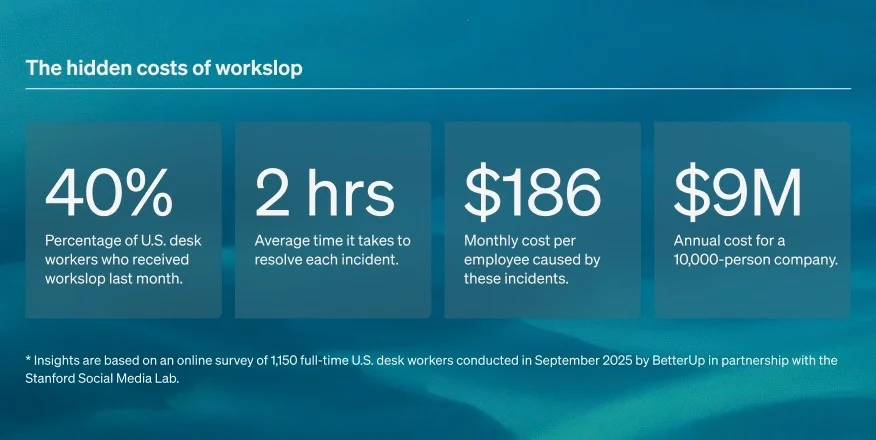
Survey results courtesy of BetterUp
The damage isn’t only financial, though. Over half of workers lose confidence in a colleague after receiving workslop. The same research found that 54% viewed AI-reliant coworkers who produced low-quality output as less creative, 42% found them less trustworthy, and 37% perceived them as less intelligent. In a small business where trust and tight-knit collaboration are crucial, that kind of erosion can be deeply corrosive.
There’s also cultural pressure at play that’s easy to underestimate. When businesses push AI adoption as a goal in itself, employees naturally feel pressured to appear productive with AI rather than actually be productive. This creates a cycle of rushed, low-quality output that scales across teams. The irony is that the businesses most aggressively chasing AI efficiency can end up furthest from it.
What You Can Do to Ensure AI Supports Healthy Productivity
As harmful as workslop may be, organizations can bring it under control with the right approach. Here’s how to get ahead of it.
1. Acknowledge Your Staff is Already Using AI
The biggest reason workslop grows is when AI use remains informal, and organizations fail to address its qualitative impact. In many organizations, adoption is already happening quietly across teams. So, rather than issuing top-down mandates to broadly increase AI usage, have an honest conversation about how people are currently using these tools. Discuss where AI is helping and where it is creating gaps.
When employees feel trusted, they are likelier to raise concerns about quality, rather than pass along poor output. Naturally, this encouraged early course correction. Over time, shared awareness makes it easier to manage a problem that would otherwise remain invisible until it causes real damage.
2. See AI as a Building Block, Not a Finished Product
AI can generate content quickly, but speed alone does not ensure depth or accuracy. The most effective implementations position AI as a starting point, such as a drafting tool or a first-pass generator. Human judgment, context, and subject-matter expertise still play a central role in shaping the final output.
When teams understand that AI-generated content requires refinement, they engage with it more thoughtfully. As a result, the quality of work improves. Where possible, involve employees in shaping the tools they use, instead of introducing a black-box vendor solution with little transparency. Greater ownership leads to stronger accountability, and therefore, people are better prepared to correct errors.
3. Define and Share Standards for AI-assisted Work
It’s important that your employees understand and, more importantly, can align quality standards within your organization. Take the time to define what good looks like for your organization, whether it’s for a client proposal, a product description, or an internal report. Then, communicate those standards clearly.
With explicit benchmarks in place, employees can more easily identify when AI output falls short. In line with this, it might also be worthwhile to add a light review step before AI-assisted work is finalized, especially for client-facing or high-stakes materials. Overall, workslop becomes rare when standards are protected consistently.
4. Measure What Matters
Organizations that measure AI adoption broadly often get very little useful data because they track a surface-level metric. Therefore, it is important to pair usage tracking with quality indicators such as client satisfaction, error rates, and rework time across all the areas that AI touches. Beyond these indicators, it is also important to qualitatively understand from employees what constitutes good work and how AI affects it.
This approach shifts attention to performance and results. In a small business, regular check-ins about where AI output is effective and where it creates friction can surface issues early. As a result, teams can respond quickly and prevent small-quality problems from compounding into larger ones.
Embrace AI with Astute Technology Management
At the end of the day, the workslop is not an argument against AI. This is an argument for using it with intention. The tools themselves are not the problem. The problem is what happens when speed becomes the only measure of success and quality quietly slips through the cracks.
For businesses of any size, AI can genuinely help people work better. But that only happens when there are standards in place, when employees feel trusted enough to flag problems, and when organizations are honest about what good work looks like.
The businesses that get this right will not just avoid the costs of workslop. They will build something more valuable: a culture where AI makes the work stronger and not just appears quicker or stronger.